

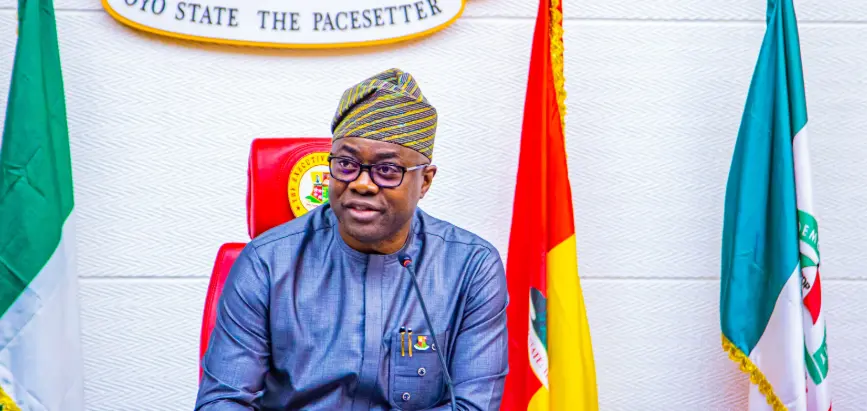
Oyo State Governor, Seyi Makinde, has shared his unease over the fact that fourteen days after the President gave his assent to the 2026 Electoral Act, he still hasn’t laid eyes on an official version of the statute.
The governor brought up this discrepancy on Friday during his speech at the 2026 Obafemi Awolowo Lecture, hosted at Efunyela Hall in Ikenne-Remo, Ogun State.
Makinde expressed disappointment that even though the new legislation is being widely talked about, the actual text remains hidden from the kind of deep public examination it deserves.
Addressing the audience at the event held to celebrate the legacy of the late statesman, Obafemi Awolowo, Makinde argued that Nigeria’s future progress hinges on the political class reaching a real agreement on the necessity of authentic federalism.
In his view, the nation’s hopes for lasting prosperity and balance can only be achieved by adopting a federal framework that mirrors the ideals famously championed by Awolowo.
The governor also called on Nigerians to face the country’s difficulties head-on, pointing out that the current state of the nation is essentially the result of the shared decisions made by those in power and the public alike.
Makinde doubled down on his commitment to a healthy multi-party democracy, arguing that the system is at its best when dissenting voices are permitted to function openly and add value to the national conversation.
Additionally, he shared his anxiety regarding the crumbling security landscape nationwide, cautioning that a failure to take firm action could lead Nigeria into a period of deep-seated chaos, not unlike the turmoil seen in the Democratic Republic of the Congo.
“We should stop thinking about the next election; we should think about the next generation,” the governor said.
Makinde concluded by noting that his leadership in Oyo State is deeply rooted in Awolowo’s approach to public service, which prioritizes rational, evidence-backed choices informed by science, logic, and dependable facts, especially within vital areas like schooling, medicine, and the economy.
