

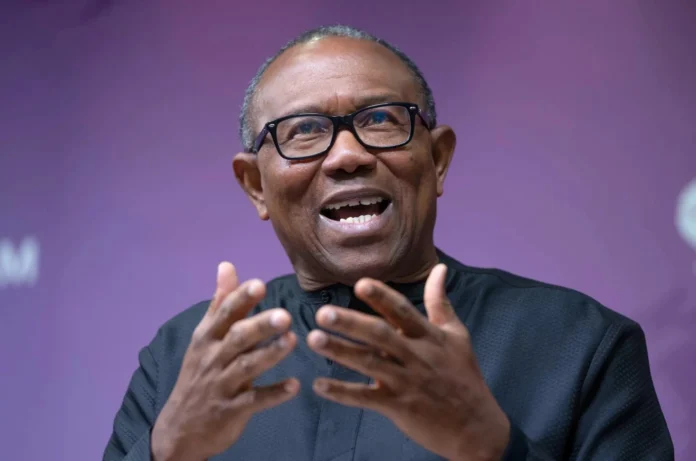
Nenadi Usman, interim national chairman of the Labour Party (LP), has said the party’s 2023 presidential candidate, Peter Obi, could be legally unable to contest the 2027 elections on its platform if he fails to meet strict membership registration requirements.
Speaking during an interview on Arise TV, Usman explained that the party is bound by provisions of the Electoral Act, which require membership registers to be closed and submitted ahead of primaries.
According to her, once this process is completed, no new entrant can be accommodated for the purpose of contesting.
“Well it will be too late actually for him to come back because if you look at the act now, at some point we close the register.
“Once we close the register 21 days before primaries, submit the register, the e-register to INEC, you can’t come from behind the door for us to register you and for you to contest the elections. That would be impossible, legally impossible anyway.”
Usman, however, acknowledged Obi’s pivotal role in the party’s strong performance during the 2023 general elections, revealing that she was among those he personally persuaded to join the LP after leaving the Peoples Democratic Party (PDP).
“Even me, he convinced me to come with him to Labour Party. Convinced me and not just me, many people that are in Labour Party today were convinced by, let’s join Peter, go to Labour Party because we believed in equity and fair play,” she said.
She added that her decision to leave the PDP was influenced by what she described as the party’s failure to zone its presidential ticket to the southern region.
“We believe that PDP should have zoned the seat to the south. But since they left it open and said there were no zoning and a northerner, they were trying to field a northerner, we felt no, it’s not fair. Though I’m a northerner but I felt it was not fair,” Usman said.
Her remarks come against the backdrop of a prolonged leadership crisis within the Labour Party following its 2023 electoral outing.
The dispute, centred on competing claims to the national chairmanship, pitched Usman’s caretaker committee against the faction led by former chairman Julius Abure.
The situation took a legal turn in April 2025 when the Supreme Court ruled that Abure’s tenure had expired.
A subsequent decision by the Federal High Court in Abuja removed him from office and directed INEC to recognise Usman’s committee as the party’s legitimate leadership pending a national convention.
Usman’s faction later assumed control of the party’s national secretariat in Utako, Abuja, amid allegations of vandalism and document theft involving Abure’s supporters. The Court of Appeal further reinforced her position, dismissing Abure’s challenge and affirming her leadership, while directing INEC to engage solely with her faction.
Despite these rulings, Abure has indicated plans to approach the Supreme Court, leaving the dispute unresolved.
The internal crisis has had significant consequences for the party, including defections, a reduced presence in the National Assembly, and a weakened grassroots structure.
Obi himself cited the prolonged instability as a factor in his decision to leave the party. In response, Usman’s leadership has begun a membership revalidation exercise and zoned the party’s 2027 presidential ticket to the southern region as part of efforts to reposition ahead of the next election cycle.
