

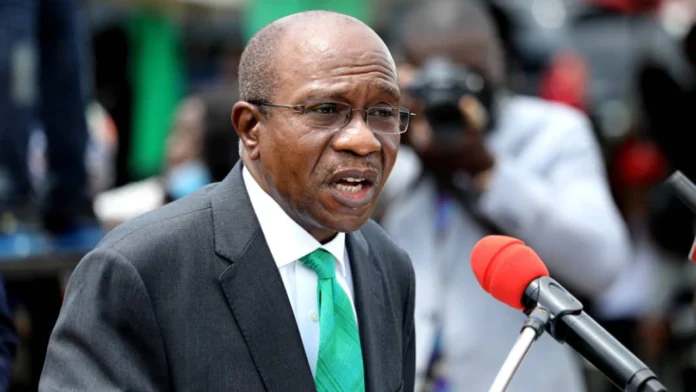
An Ikeja Special Offences Court on Friday scheduled April 17 for the adoption of final written addresses in a trial-within-trial involving Henry Omoile, who is standing trial alongside former Central Bank of Nigeria (CBN) governor, Godwin Emefiele.
Emefiele is facing a 19-count charge that includes allegations of gratification, corrupt demands, and abuse of office linked to large-scale financial transactions.
His associate, Omoile, is being prosecuted on a three-count charge bordering on the alleged unlawful acceptance of gifts while acting as an agent in transactions connected to the CBN.
The charges relate to financial dealings valued at about 4.5 billion dollars and N2.8 billion, which the prosecution claims represent significant breaches of trust and established procedures.
During proceedings on Friday, Justice Rahman Oshodi adjourned the matter to allow both sides adopt their final written addresses in the trial-within-trial after the cross-examination of Omoile.
The judge also directed the prosecution and defence to file and exchange their written submissions starting from March 23 ahead of the scheduled adoption.
The News Agency of Nigeria (NAN) reports that the trial-within-trial was initiated to determine whether the statement obtained from Omoile by investigators of the Economic and Financial Crimes Commission (EFCC) was made voluntarily.
While being cross-examined by EFCC counsel, Mr Rotimi Oyedepo (SAN), Omoile alleged that he was pressured, threatened, and promised freedom if he followed the directives of EFCC operatives.
He told the court that he eventually gave false statements after investigators assured him he would be released if he cooperated with them.
Oyedepo informed the court that the anti-graft agency had already filed a counter-affidavit disputing the defendant’s claims of coercion.
However, he noted that the defence had not yet filed a response to the affidavit.
Counsel to Omoile, Mr Adeyinka Kotoye (SAN), challenged the prosecution’s stance, arguing that the key issue before the court was whether the statement was voluntarily made.
He maintained that the defence’s objection was based on claims that the defendant had been subjected to threats, coercion, and inducements while in EFCC custody.
NAN also reports that Omoile’s lawyer, Mr Nnamdi Ofia, earlier alleged during the trial-within-trial on Jan. 15 that the EFCC attempted to pressure the defendant into implicating Emefiele during interrogation.
Ofia, who testified in the proceedings, claimed investigators promised Omoile bail and suggested he might not face charges if he produced incriminating evidence against Emefiele.
He told the court that the interrogation was conducted in a question-and-answer format and that investigators demanded “satisfactory” responses before permitting Omoile to write them on his statement sheet.
According to Ofia, some responses from his client were rejected because they did not correspond with what investigators expected.
He further claimed that the situation became tense when he questioned the interrogation process and that he was eventually asked to leave the EFCC premises by an officer identified as David.
However, under cross-examination, Ofia acknowledged that Omoile was cautioned in his presence before making the statement and that he signed the caution form.
He also confirmed that he took part in the statement-taking process and understood that whatever his client wrote could later be used as evidence in court.
Ofia also admitted that he did not submit any petition or formal complaint against the EFCC over the alleged misconduct.
He further stated that the judge who previously handled a fundamental rights enforcement suit filed on behalf of Omoile did not rule that the anti-graft agency acted improperly.
NAN reports that final written addresses in the trial-within-trial are expected to be adopted on April 17.
