

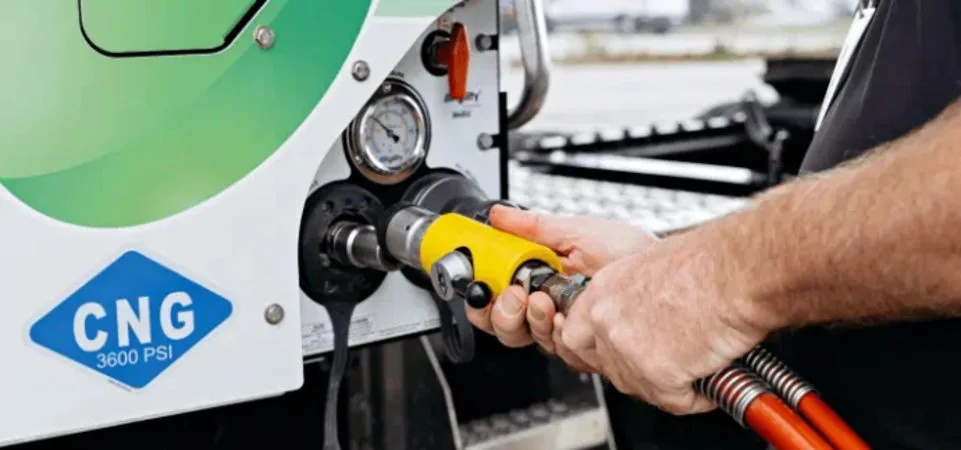
The Presidential Compressed Natural Gas Initiative has partnered with major financial institutions to facilitate access to affordable credit for the conversion of vehicles to compressed natural gas (CNG), in a move aimed at reducing energy costs and accelerating adoption among low-income Nigerians.
The initiative, which involves Moniepoint Microfinance Bank Limited, the Nigerian Consumer Credit Corporation, and the National Credit Guarantee Company Limited, seeks to eliminate the financial barriers associated with the upfront cost of conversion kits and installation.
Speaking at the flag-off ceremony in Abuja, the Chief Executive Officer of the programme, Ismaeel Ahmed, explained that the initiative is designed to directly address affordability challenges that have hindered widespread adoption of CNG.
“This is a very significant partnership. What we are doing here is to ask a simple question: what is the barrier for Nigerians to switch to CNG? And the answer is clear, it is the cost of the conversion kit and installation.
“We are reducing that barrier. Not only are we bringing down the cost, but we are also ensuring that these kits are supplied at cost. There is no profit margin built into it, because the goal is mass adoption and not profit-making.”
Under the new financing framework, vehicle owners will be able to spread the cost of conversion over a defined period, rather than making a one-time payment. This approach is expected to significantly improve access for commercial drivers and small-scale operators.
Ahmed elaborated, “Instead of paying, for example, N100,000 upfront for conversion, you can now pay that amount over several months, six months, or even shorter, depending on your agreement with the financial institution. That flexibility is what makes this initiative powerful.
“Some people may decide they want to finish repayment in one month. Others may spread it over six months. The key thing is that the convenience is there, and affordability is now within reach for everyday Nigerians.”
The programme also highlights the potential cost savings associated with CNG adoption, particularly for transport operators.
Ahmed illustrated this by stating, “If a keke rider spends about N40,000 weekly on petrol and another N10,000 weekly on maintenance, that is N50,000 every week. With CNG, that same rider could reduce fuel costs by about 60 to 70 per cent and cut maintenance from N10,000 weekly to about N10,000 monthly.
“So, you are saving roughly N30,000 on maintenance alone every month. On fuel, if you were buying petrol at around N1,300 equivalent, you could be buying gas at about N400. The savings are substantial and immediate.”
In addition, the Managing Director of the Nigerian Consumer Credit Corporation, Uzoma Nwagba, stated that the initiative forms part of broader efforts to ensure that economic reforms deliver tangible benefits to citizens.
He said, “When this administration started, there were major reforms, exchange rate unification and subsidy removal. These reforms have improved the macroeconomic environment, but the big question has always been: what about the people at the bottom?
“The CNG initiative and consumer credit scheme are specifically designed to answer that question. They are targeted at everyday Nigerians, transport workers, small business owners, people who feel the impact of high energy costs the most.”
Nwagba further noted that the financing model significantly lowers borrowing costs compared to prevailing market rates.
He explained, “Today, if you try to get a personal loan from many institutions, you could be paying interest rates of 4 per cent per month, and in some cases up to 10 per cent per month. That translates to between 48 per cent and 120 per cent annually.”
He contrasted this with the new scheme, stating, “With CreditCorp-supported facilities, we are seeing loans as low as 9 per cent annually, and for higher-risk individuals, around 20 to 24 per cent. That is a massive reduction. Imagine moving from 48 per cent to 9 per cent, that is the kind of impact we are talking about.”
The government also disclosed that an initial batch of 100,000 CNG conversion kits is immediately available, with plans for nationwide expansion.
Nwagba said, “Even before global energy prices began rising, there was already a need to reduce energy costs for Nigerians. Now, with hundreds of thousands of kits available, the focus is on making them accessible through financing.
“We are calling on all financial institutions to join this initiative. It does not stop with the current partners. The goal is to provide affordable credit to millions of Nigerians.”
Also speaking, Tobi Amirah noted that the partnership aligns with broader efforts to address rising transportation costs.
She said, “One of the things we are focused on is doing things that impact our customers and Nigerians as a whole. Our data shows that transportation cost is a major challenge for businesses and individuals, and this partnership is designed to solve that problem.”
Beyond CNG adoption, the government indicated that it is also promoting electric vehicles through supportive policies and infrastructure expansion.
Ahmed disclosed, “The President has approved zero import duty on electric vehicles to encourage adoption. We are also working with partners like the Rural Electrification Agency and NNPC Retail to deploy charging stations across the country.”
He added, “We are exploring new technologies that could even allow switching from petrol to electric systems. Discussions are ongoing, and once we have concrete outcomes, we will share them.”
The initiative is part of broader economic reforms under Bola Tinubu, including subsidy removal and exchange rate adjustments, which have increased energy and transportation costs.
In response, the government has introduced complementary programmes such as consumer credit schemes and energy transition initiatives aimed at cushioning the impact on citizens.
Ahmed concluded, “Energy cost reduction is something that can radically improve people’s lives. This is not just about vehicles; it is about giving Nigerians the tools to lower their daily expenses and improve their quality of life.”
