

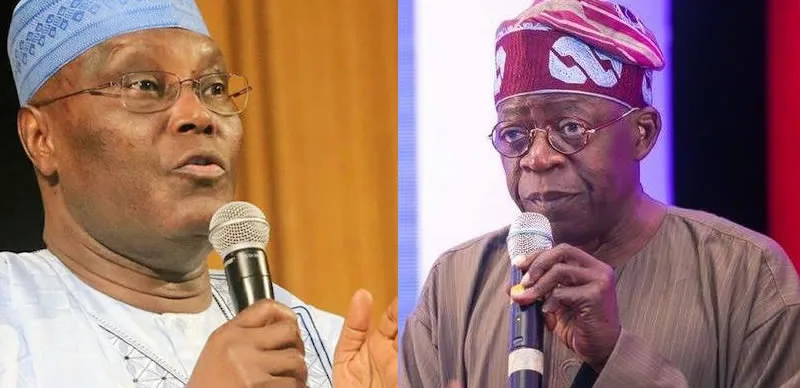
Former Vice President Atiku Abubakar has sharply criticized President Bola Ahmed Tinubu, accusing him of inconsistency and rewriting history for political convenience.
Through his spokesperson, Phrank Shaibu, Atiku reacted to Tinubu’s recent comments questioning his credentials and past economic decisions, describing them as misguided and revealing deeper contradictions.
“Atiku Abubakar’s attention has been drawn to the latest reckless tirade by President Bola Ahmed Tinubu—a performance that exposes not just desperation, but a troubling pattern of hypocrisy and historical amnesia,” the statement read.
Atiku’s camp questioned the logic behind Tinubu’s criticism, noting that the president himself has faced scrutiny over his academic records. They argued it was surprising for someone under such pressure to attempt to undermine another public figure with a documented service history.
The disagreement also extends to economic reforms, particularly privatization. Atiku has long supported transferring key national assets, including the Nigerian National Petroleum Corporation (NNPC), to credible private investors. His camp now claims Tinubu once resisted such ideas but appears to be implementing a version of them in office—albeit without transparency.
“This is not reform; it is privatization without accountability,” Atiku stated.
The statement went further, taking aim at Tinubu’s educational background:
“It is not our fault that the president does not and cannot read, because Bola Tinubu has a history of attending a school in Lagos two years before it was founded, upon which he claimed his Chicago State University degree.
“If he were properly educated, he would have acquainted himself with the privatization records in the presidency or the painstaking account of these reforms as captured by Mallam Nasir El-Rufai in The Accidental Public Servant, where the privatization programme was clearly documented as a bold and structured effort to dismantle inefficiency and drive private sector-led growth.”
Concluding, Atiku’s team suggested that Tinubu’s remarks reflect a lack of engagement with established facts.
“You cannot oppose reform when it demands courage and then execute a shadow version of it in power,” the statement added.
