

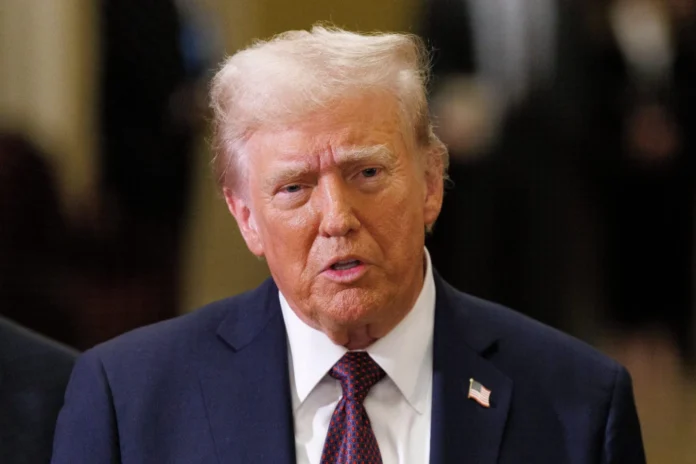
President Donald Trump on Friday sharply criticised NATO allies, calling them “cowards” and describing the alliance as a “paper tiger” without the United States, in a dispute over reluctance to support U.S.-led military efforts to secure the Strait of Hormuz amid the ongoing conflict with Iran.
In a post on his Truth Social platform, Trump accused member nations of refusing to participate in operations aimed at reopening the critical shipping route, which has effectively been blockaded by Iranian forces.
The strait, which normally carries about 20 percent of the world’s oil supply, has seen its closure drive global energy prices sharply higher.
“Without the U.S.A., NATO IS A PAPER TIGER!” Trump wrote.
“They didn’t want to join the fight to stop a Nuclear Powered Iran. Now that fight is Militarily WON, with very little danger for them, they complain about the high oil prices they are forced to pay, but don’t want to help open the Strait of Hormuz, a simple military maneuver that is the single reason for the high oil prices,” he stated.
He added: “So easy for them to do, with so little risk. COWARDS, and we will REMEMBER!”
The remarks represent the latest in Trump’s longstanding criticism of NATO, which he has repeatedly accused of not sharing the defense burden equitably.
However, the timing has heightened concerns among European allies already dealing with the economic impact of the conflict and seeking to avoid direct involvement in hostilities with Iran.
Several European leaders have declined to commit military resources to secure the strait while active fighting continues.
French President Emmanuel Macron said France would not participate in operations “to open or liberate the Strait of Hormuz in the current context,” describing the conflict as one initiated by the U.S. and Israel without consultation with allies.
A day before Trump’s comments, several major powers—including NATO members Britain, France, Germany, and Italy, alongside Japan—had indicated their “readiness to contribute to appropriate efforts” to ensure safe passage through the strait, though without pledging direct military involvement.
Germany and Italy have maintained they will not take action until a ceasefire is achieved.
NATO Secretary General Mark Rutte had earlier expressed confidence that the alliance would reach a unified approach, though Trump’s remarks appeared to undercut ongoing diplomatic efforts.
The conflict with Iran began on February 28 following a joint offensive by the United States and Israel. Since then, Iran has responded with drone and missile strikes across the Gulf region, targeting infrastructure in the United Arab Emirates, Kuwait, and Saudi Arabia.
